
LTL, PTL, FTL or Express: Which Freight Service Fits?
Choose a pallet freight service by deadline, handling and capacity. Compare shared, full-truck and express options, then prepare a usable operating brief.
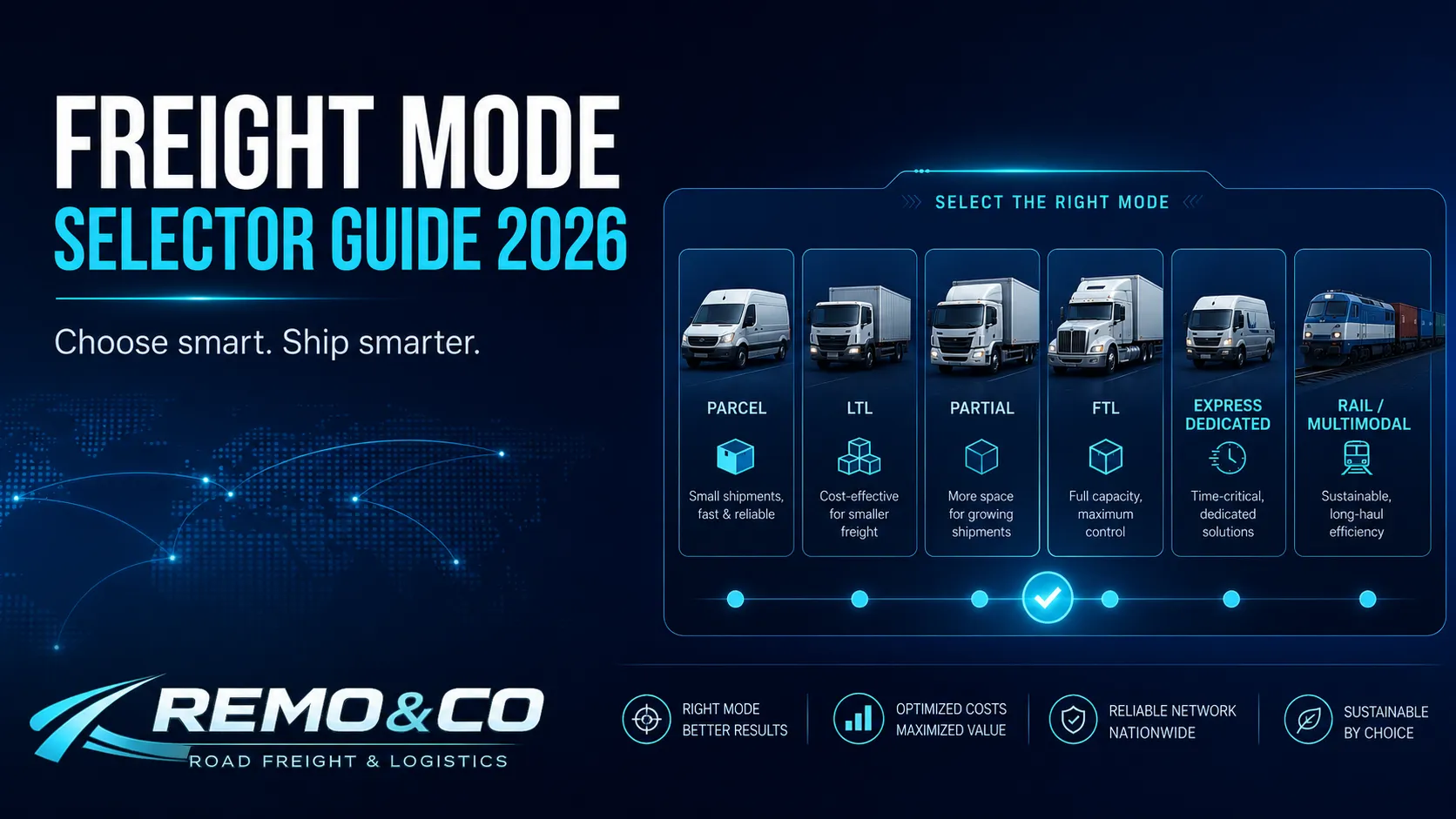
Choose the operating plan before the label
For palletised road freight, start with three constraints: when the goods are ready, the latest acceptable arrival and how they may be handled. Then check whether shared capacity, a reserved vehicle or a time-critical service can meet them. Pallet count alone cannot choose the service.
LTL means less-than-truckload: your shipment shares capacity. PTL, or partial truckload, also uses part of a vehicle; the distinction from LTL varies between providers. FTL reserves the truck for the shipment, even when it is not physically full. Dedicated describes exclusive use of an agreed vehicle. Express describes a time-sensitive service, so ask how it will actually operate.
The carrier descriptions from LOXX and DHL help distinguish shared capacity from full-vehicle bookings. Their product conditions are not Remo&Co commitments. For your shipment, confirm co-loading, collection stops, terminal handling and vehicle changes explicitly.
A decision table for the service enquiry
| Shipment constraint | Option to investigate | Acceptance needed |
|---|---|---|
| Flexible receiving window; standard packed pallets | LTL or PTL with shared capacity | Collection window, delivery range, co-loading and planned handling |
| Goods must remain on the same vehicle | Confirmed direct partial load, or dedicated vehicle | No unloading or reloading en route; any other stops disclosed |
| Shipment needs exclusive loading space | FTL or a suitably sized dedicated vehicle | Usable dimensions, payload, loading access and exclusivity |
| A missed deadline would interrupt operations | A feasible express or dedicated service | Goods-ready time, collection cutoff, arrival commitment and contingency contact |
These are starting points, not automatic recommendations. Non-stackable freight may occupy a large floor area despite a modest pallet count. Check the pallet and vehicle-capacity guide, then have the actual packed dimensions and gross weights accepted.
Three shipments, three different decisions
Flexible shared load: six wrapped pallets are ready on Monday and the receiver accepts delivery from Tuesday to Thursday. Ask for LTL or PTL, stating whether stacking and terminal handling are permitted. If the receiver changes this to a fixed Tuesday appointment, reassess the service before booking; the original delivery range no longer answers the requirement.
Restricted handling: two crated machines may share a vehicle, but must not be unloaded between collection and delivery. Ask whether a direct partial-load option can meet that condition. If it cannot, investigate a dedicated vehicle of suitable capacity. Writing “fragile” on the request does not establish a no-transfer agreement.
Urgent deadline: replacement components are ready late in the afternoon for a morning delivery. Start with the real readiness time, distance, receiving access and available vehicle. Express is only useful if the plan is feasible, including applicable driving and rest requirements. If the deadline cannot be confirmed, agree a revised arrival with the receiver before dispatch. These examples are illustrative, not completed Remo&Co shipments.
Send an operating brief the dispatcher can use
- Places: complete collection and delivery addresses, access restrictions, site contacts and opening hours.
- Time: goods-ready date and time, loading slot, latest arrival, appointment reference and flexibility at each end.
- Cargo: goods description, unit count, packed length × width × height, gross weight per unit, overhang and stackability.
- Handling: forklift or dock availability, side/rear loading, tail-lift requirement and responsibility for loading and unloading.
- Service: permitted co-loading, extra stops, terminal transfers and vehicle changes; state every prohibited operation.
- Control: shipment reference, document readiness, update contacts and required proof-of-delivery timing.
Before accepting, ask for written confirmation of the chosen service and both booking windows. If the size, readiness, access or deadline changes, request a new feasibility check. Compare the price of workable options using the partial-load versus full-truckload quotation guide.
Questions about LTL, FTL and express freight
Does LTL always involve a terminal transfer?
No. The operating model depends on the service. Ask whether the goods stay on one vehicle, pass through a terminal or are reloaded, and obtain acceptance of any handling restriction.
Must I fill every pallet position to book FTL?
No. FTL reserves truck capacity; it does not require full physical occupancy. Exclusive use may be relevant for handling or scheduling requirements as well as volume.
Does FTL guarantee a nonstop journey?
No. Exclusivity does not remove driver breaks or establish every routing condition. Agree direct carriage, additional stops and any permitted vehicle or cargo transfer separately.
Is express freight always carried in a dedicated vehicle?
No universal rule applies. Confirm exclusivity, co-loading and transfers. An express label alone also does not confirm collection today or delivery tomorrow.
When should I send the booking request?
As soon as the operational brief is reliable. Ask for the service's booking cutoff and confirmation deadline; there is no single lead time suitable for every lane and shipment.
Prepare the next decision
Use the freight mode selector to organise the constraints and the freight enquiry generator to structure the request. These tools provide planning guidance, not capacity confirmation. Read the dedicated vehicle guide if exclusivity matters, then send Remo&Co your shipment brief for an assessment of the available options.

Related Posts
LTL vs FTL: compare quotes for the same pallet shipment
Compare part-load and full-truck quotes using identical cargo, dates and handling requirements, with a worked cost example and a reusable comparison sheet.
How many pallets fit in a truck? Non-stackable loads and loading metres
Calculate pallet floor space, compare loading metres with complete rows, and prepare packed dimensions, weight and stacking limits for a vehicle check.
Dedicated Delivery Truck: When It Is Worth the Cost
A practical guide to Dedicated Delivery Truck: When It Is Worth the Cost, with decision tables, operator checklists, free Remo&Co tools and source-backed notes where compliance matters.