
How Many Pallets Fit in a Delivery Truck?
A practical guide to How Many Pallets Fit in a Delivery Truck?, with decision tables, operator checklists, free Remo&Co tools and source-backed notes where compliance matters.
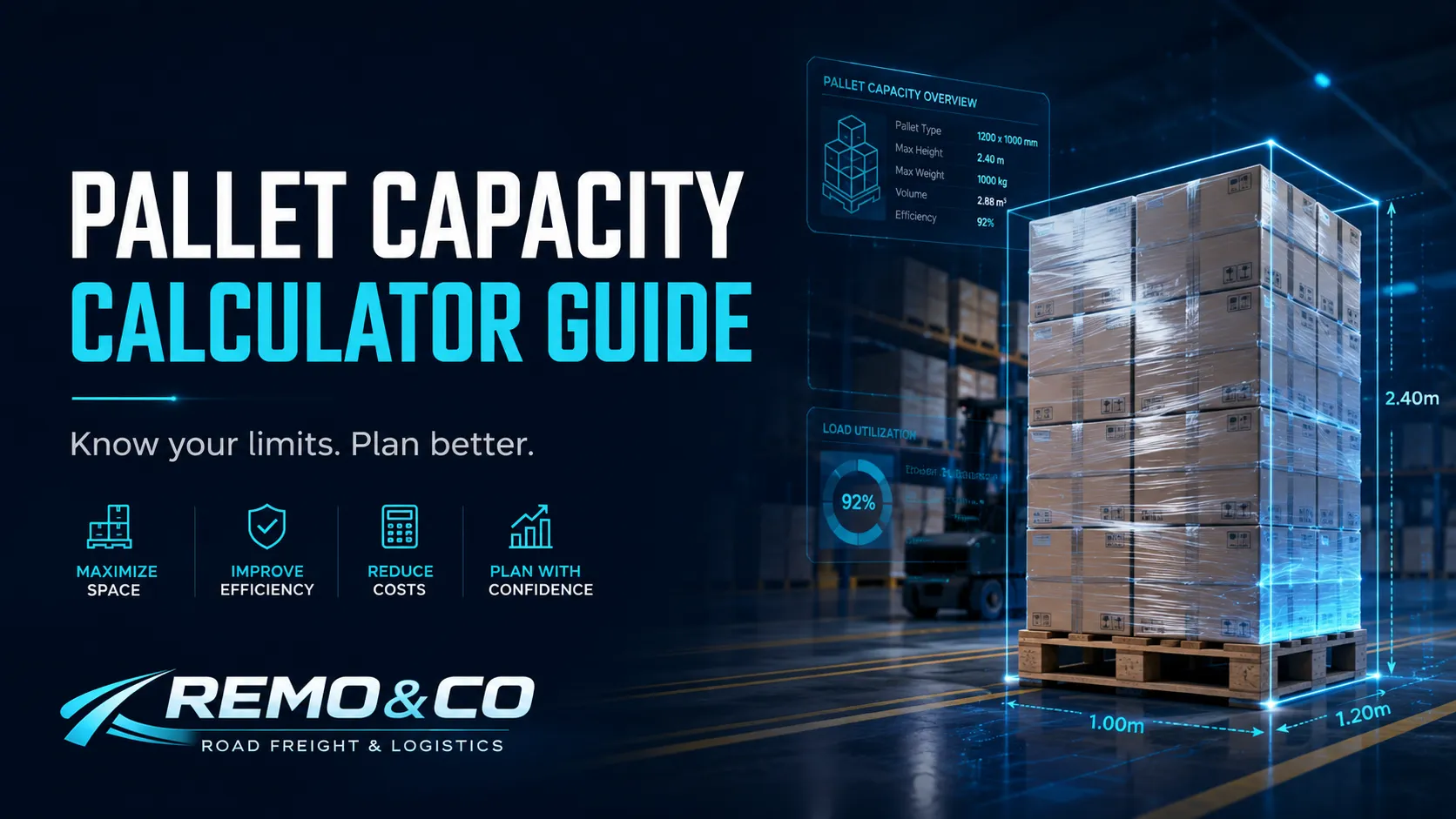
The practical answer
How Many Pallets Fit in a Delivery Truck? answers a practical freight question, not a theoretical one. The aim is to help a shipper, buyer or operations team make a better decision before the truck is booked.
The right vehicle is the smallest compliant vehicle that can carry the cargo safely, legally and on time. Dimensions, weight, stackability, loading access and urgency matter more than the generic word “truck”.
Primary SEO focus: delivery truck. The operational focus is simple: turn a vague delivery request into a clear transport decision with fewer surprises.
Why this matters
A vehicle that is too small creates overload and compliance risk. A vehicle that is too large adds cost and may fail at urban delivery points. Vehicle choice is a service decision, not only a price decision.
In European road freight, the best answer is rarely “the cheapest carrier”. The better question is: what must be true for this delivery to succeed? That means checking time, cargo, access, documents, route risk and the level of control required.
Decision framework
| Situation | Best decision | Why it matters |
|---|---|---|
| Small urgent cartons | Express van | Fast access and low loading complexity |
| Several pallets, urban delivery | Rigid truck or tail-lift vehicle | Better balance of capacity and access |
| Large FTL volume | 13.6 m semi-trailer | Most efficient for full-truckload movements |
| Light but high-volume freight | Mega trailer if route allows | Height and volume matter more than weight |
| Temperature-sensitive goods | Refrigerated vehicle | Cargo conditions must match the transport plan |
Operator checklist
This checklist turns the article into an operational brief. Use it before asking for a quote or confirming a delivery slot.
- Pallet type and dimensions
- Total weight and height
- Stackable or non-stackable
- Tail-lift or dock access
- Side loading or rear loading
- Domestic or international route
Mistakes to avoid
- Choosing the vehicle only by price
- Ignoring access restrictions at pickup or delivery
- Forgetting non-stackable height
- Assuming a van is always simpler for international work
How Remo&Co helps
Remo&Co combines own fleet capacity with trusted carrier partnerships, operators, drivers and data-minded workflows. For a shipper, that means the conversation can move beyond “price please” and into a clearer answer: vehicle fit, time feasibility, document readiness and risk.
Free tool: Pallet Capacity Calculator. Use the recommended tool, copy the result into your RFQ and send it to Remo&Co for operator review.
FAQ
What is the first thing to check?
Start with the constraint that cannot move: delivery deadline, cargo readiness, vehicle access, documents or budget. The best transport decision protects that constraint first.
When should I ask for a dedicated vehicle?
Use a dedicated vehicle when the shipment is urgent, palletized, high value, appointment-critical, fragile, or needs fewer handovers and faster POD.
Which free Remo&Co tool should I use?
Use the tool linked in this article. It turns the operational question into structured data that Remo&Co can validate faster.
Sources and further reading
- Pallet Capacity Calculator — practical Remo&Co tool connected to this guide.
Need a transport decision checked by an operator? Send the result to Remo&Co and get a confirmed transport option.

Related Posts
 Delivery vehicles
Van, Porteur or Semi-Trailer: Which Camion Livraison Do You Need?
A practical guide to Van, Porteur or Semi-Trailer: Which Camion Livraison Do You Need?, with decision tables, operator checklists, free Remo&Co tools and source-backed notes where compliance matters.
 Delivery vehicles
3.5t Van Delivery in Europe: What Changes in 2026?
A practical guide to 3.5t Van Delivery in Europe: What Changes in 2026?, with decision tables, operator checklists, free Remo&Co tools and source-backed notes where compliance matters.
 Express delivery
How to Book Express Delivery in Europe: Your 2026 Guide
A practical guide to How to Book Express Delivery in Europe: Your 2026 Guide, with decision tables, operator checklists, free Remo&Co tools and source-backed notes where compliance matters.