
What to Do After Cargo Damage: A CMR Claim Guide
A practical guide to What to Do After Cargo Damage: A CMR Claim Guide, with decision tables, operator checklists, free Remo&Co tools and source-backed notes where compliance matters.
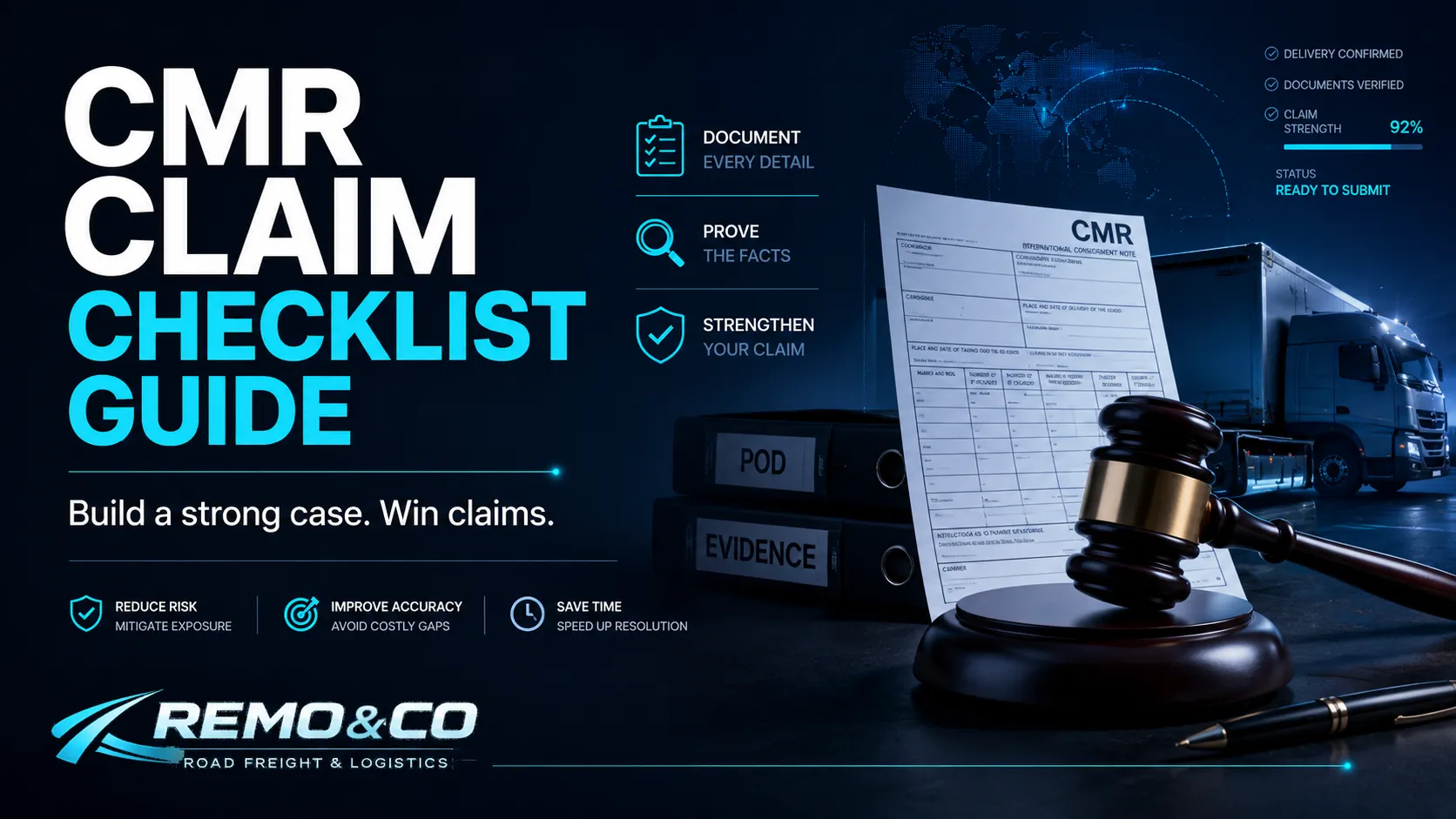
The practical answer
What to Do After Cargo Damage: A CMR Claim Guide answers a practical freight question, not a theoretical one. The aim is to help a shipper, buyer or operations team make a better decision before the truck is booked.
Proof of delivery is not just a signature. A strong shipment file includes the transport order, CMR or POD, timestamps, quantity evidence, seal records, photos where needed, and any written reservations.
Primary SEO focus: CMR POD proof of delivery. The operational focus is simple: turn a vague delivery request into a clear transport decision with fewer surprises.
Why this matters
Documentation protects the shipper, consignee, carrier and operator. It speeds invoicing, reduces disputes and gives evidence if damage, shortage or delay becomes a claim.
In European road freight, the best answer is rarely “the cheapest carrier”. The better question is: what must be true for this delivery to succeed? That means checking time, cargo, access, documents, route risk and the level of control required.
Decision framework
| Situation | Best decision | Why it matters |
|---|---|---|
| Visible damage at delivery | Write reservations before signing | A clean signature weakens the evidence file |
| High-value cargo | Add photos, seal numbers and POD timing | Evidence should be created before a dispute starts |
| International road shipment | Prepare CMR and shipment order | The transport file should match the actual movement |
| Invoice depends on POD | Define POD return time | Fast documents shorten the cash cycle |
| Multiple attachments | Merge and label the document pack | A clean file reduces internal friction |
Operator checklist
This checklist turns the article into an operational brief. Use it before asking for a quote or confirming a delivery slot.
- Transport order
- CMR or POD
- Quantity and weight evidence
- Seal number
- Photos if needed
- Delivery reservations process
Mistakes to avoid
- Signing clean when damage is visible
- Separating photos from the shipment file
- Not defining POD return expectations
- Sending many unlabeled attachments
How Remo&Co helps
Remo&Co combines own fleet capacity with trusted carrier partnerships, operators, drivers and data-minded workflows. For a shipper, that means the conversation can move beyond “price please” and into a clearer answer: vehicle fit, time feasibility, document readiness and risk.
Free tool: CMR Claim Checklist Generator. Use the recommended tool, copy the result into your RFQ and send it to Remo&Co for operator review.
FAQ
What is the first thing to check?
Start with the constraint that cannot move: delivery deadline, cargo readiness, vehicle access, documents or budget. The best transport decision protects that constraint first.
When should I ask for a dedicated vehicle?
Use a dedicated vehicle when the shipment is urgent, palletized, high value, appointment-critical, fragile, or needs fewer handovers and faster POD.
Which free Remo&Co tool should I use?
Use the tool linked in this article. It turns the operational question into structured data that Remo&Co can validate faster.
Sources and further reading
Need a transport decision checked by an operator? Send the result to Remo&Co and get a confirmed transport option.

Related Posts
 Documents & proof
CMR vs POD: What Proof of Delivery Really Means
A practical guide to CMR vs POD: What Proof of Delivery Really Means, with decision tables, operator checklists, free Remo&Co tools and source-backed notes where compliance matters.
Documents & proof10 Freight Documents Every B2B Shipment Should Have
A practical guide to 10 Freight Documents Every B2B Shipment Should Have, with decision tables, operator checklists, free Remo&Co tools and source-backed notes where compliance matters.