
Shipping pallets to Switzerland: prepare the customs handover
Sending pallets from the EU to Switzerland? Agree the importer, customs documents, crossing hours and release instructions before arranging collection.
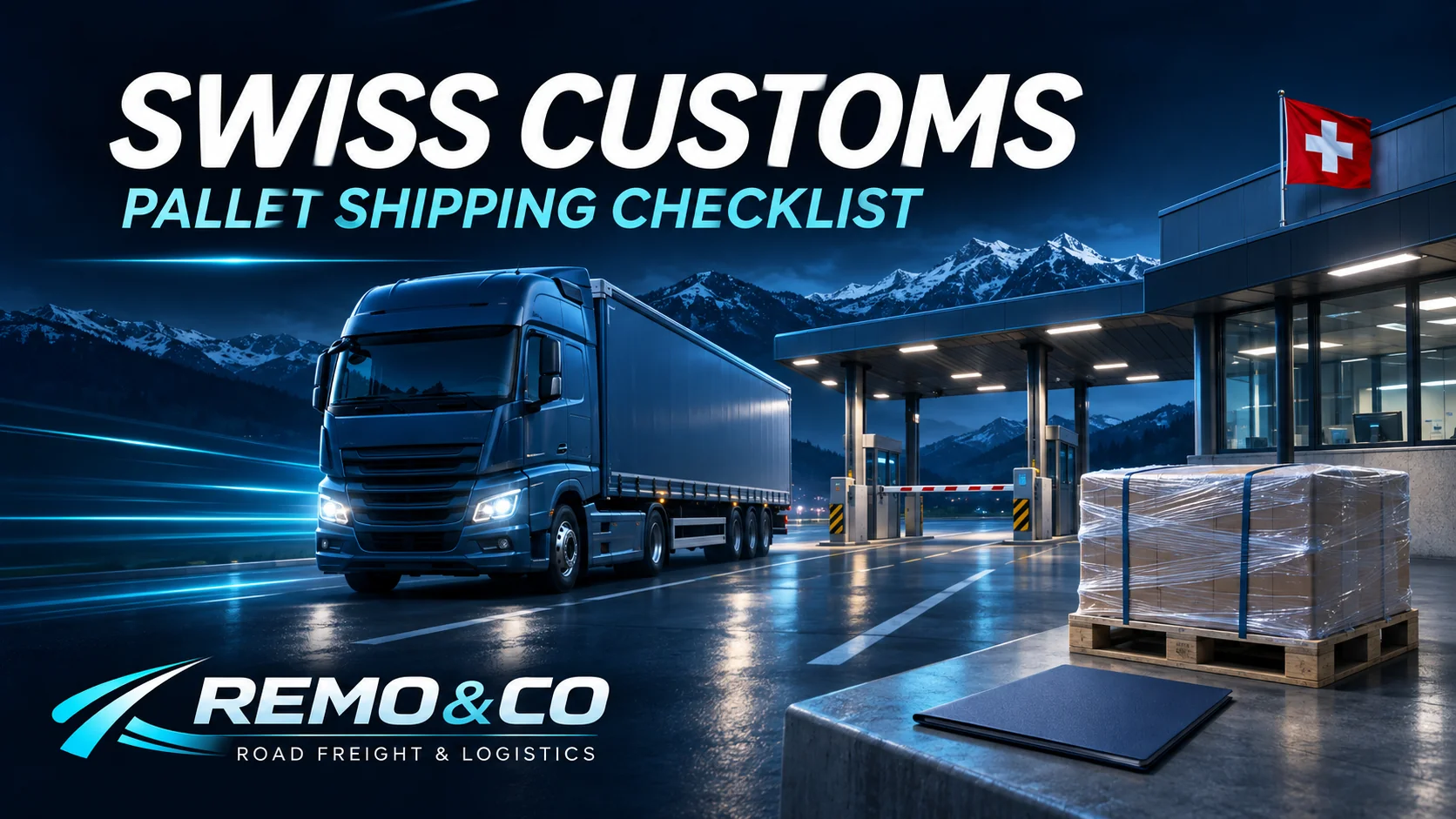
A pallet shipment from the EU to Switzerland needs a transport booking and a workable customs arrangement. Before collecting the goods, establish who prepares the declarations, which border office can handle them and what the driver needs. A truck arriving on time cannot resolve an unidentified importer or a missing invoice.
This checklist is for businesses sending commercial goods into Switzerland by road. Use it to coordinate the supplier, Swiss customer, appointed customs representative and transport provider. Returns, repairs and temporary movements need their purpose identified at the outset.
Build one consistent shipment file
The Swiss customs import checklist requires commercial goods to be declared and identifies the accompanying documents to check. Your declarant determines the requirements for the actual goods and procedure. Give them a complete file early enough to query discrepancies.
- Commercial invoice: identify the seller, buyer and intended importer, describe the goods precisely, and state quantities, value and currency. Explain a no-sale movement instead of inventing a sale price.
- Packing list: connect each pallet or package to its contents. Include package count, gross weight, relevant net weights and packed dimensions. Make the totals reconcile with the invoice.
- Classification and origin: supply product details for the tariff classification and evidence of origin where applicable. A collection address alone does not establish origin.
- Commercial arrangement: record the agreed Incoterm and named place, plus the parties responsible for customs work and charges. See our EXW/FCA supplier collection guide.
- Special conditions: flag restrictions, permits, batteries, repairs or temporary use for review. Include the importer's and declarant's operational contacts.
Keep a dated version of the file. If a supplier adds a pallet after review, send the revised invoice and packing list to everyone who uses them. An old attachment with the same filename can leave the driver and declarant working from different totals.
Agree who confirms each step
Use this as an allocation of work to agree, not a substitute for the sales contract or customs mandate. A transport order does not by itself appoint a customs representative.
| Step | Contact to identify | Confirmation to retain |
|---|---|---|
| Goods and invoice data | Supplier or exporter | Final contents, quantities, weights and value |
| Swiss import arrangement | Importer and appointed declarant | Procedure, required evidence and payment arrangements |
| Collection and border plan | Transport provider with the declarant | Suitable crossing, expected arrival and driver instructions |
| Customs status | Declarant and carrier | Required references and how release will be confirmed |
| Delivery appointment | Receiving site | Accepted slot, unloading equipment and change contact |
Before loading, obtain confirmation that the information is complete for the planned procedure and that instructions are understood. Ask when formal release will occur; it may depend on presentation or checks at the border. A completed CMR records transport information and does not establish customs release.
Match the crossing to commercial clearance hours
Check the chosen office in the official customs directory. A road crossing accessible to traffic is not necessarily available for the required commercial clearance. Confirm both sides of the border, the procedure supported, the intended arrival time and any appointment or authorisation needed.
Give the carrier a reachable customs contact and a plan for a missing reference, inspection or missed opening window. Ask who advises the receiver if the slot changes and how waiting is charged. Do not convert a digital submission receipt into permission to proceed; the responsible parties must check the applicable release status.
Separate industrial duties, VAT and service charges
Switzerland abolished industrial tariffs on 1 January 2024. SECO confirms that customs declarations and other taxes, including VAT, remain. The industrial scope also has exceptions, notably certain agricultural goods. Preferential-origin evidence depends on the goods and their intended use or re-export; an EUR.1 is not automatically required for every pallet.
Ask the declarant to confirm the treatment and the quote to distinguish transport, declaration services, taxes or duties and waiting. Agree who pays each component before dispatch. A freight price alone does not establish the shipment's total import cost.
Autumn 2026: two targeted checks
Passar contingency: on 13 October 2026, Swiss customs announced updated transport emergency procedures. Ask the declarant which procedure and office contact apply if transmission or activation fails. This announcement does not mean every import has already moved to Passar: the dedicated roadmap currently gives 30 September 2027 as the planned last date for an e-dec import declaration.
End-use duty relief: changes apply from 1 November 2026 to affected imports claiming relief linked to their use. Have the importer and declarant check the new commitment and business-partner identification requirements. Specific exceptions exist, including a provision for certain small consignments. This is not a new universal permit for ordinary pallet freight.
Example: four pallets from Lyon to Zurich
Illustrative brief: four pallets of machined components, each 120 × 80 × 130 cm, total gross weight 900 kg, invoice value EUR 18,000. The Lyon supplier loads by forklift; the Zurich customer accepts delivery by appointment. The agreed collection place and commercial terms are included.
Attach the invoice and packing list, identify the Swiss importer and declarant, and ask the carrier to coordinate a suitable crossing. If the supplier changes the quantity, reconfirm the file and journey before collection. These example figures establish neither a tariff classification nor a tax amount, vehicle choice or transit guarantee.
Practical questions
Does an EU shipment need Swiss customs formalities?
Yes. Commercial imports must be declared. Confirm the export, transit if applicable, and Swiss import arrangements with the appointed specialists.
Does the CMR replace the customs declaration?
No. Keep the transport document, customs references and release instructions together, but verify their different purposes.
Is a packing list enough to book transport?
It helps describe the load. The carrier also needs addresses, readiness, access and receiving constraints; the declarant needs the appropriate commercial and customs evidence.
Must every buyer register for Passar immediately?
No universal buyer registration follows from this checklist. Agree the current procedure with the declarant and consult the official transition guidance.
Can a return use the original sale documents unchanged?
Identify the return and send the original references for review. The declarant must determine the suitable procedure and supporting evidence for this movement.
Send a brief that both teams can use
Prepare your shipment file, use the freight enquiry generator and request a Switzerland pallet transport quote. State which customs arrangements are already agreed and which need clarification so Remo&Co can assess the transport requirement.
Sources checked on 8 November 2026. Confirm the actual goods, procedure and crossing arrangements with your declarant and carrier before dispatch.

Related Posts
EXW or FCA: prepare a pallet collection from your supplier
Bought goods EXW or FCA? Confirm the named place, packed dimensions, loading equipment and receiving slot with this supplier collection worksheet.
How to Prepare a Road Freight Shipment File
A practical guide to How to Prepare a Road Freight Shipment File, with decision tables, operator checklists, free Remo&Co tools and source-backed notes where compliance matters.
CMR vs POD: What Proof of Delivery Really Means
A practical guide to CMR vs POD: What Proof of Delivery Really Means, with decision tables, operator checklists, free Remo&Co tools and source-backed notes where compliance matters.