
Sustainable Freight: Practical Steps to Reduce Your Carbon Footprint
Actionable strategies for reducing carbon emissions in European freight operations without sacrificing efficiency or profitability.
The Business Case for Green Freight
Sustainability in freight is no longer a nice-to-have corporate initiative — it is a business imperative. European regulators are tightening emissions standards, customers are demanding transparency in supply chain carbon footprints, and financial institutions are increasingly factoring ESG performance into lending and investment decisions.
The good news is that many of the most effective carbon reduction strategies also improve operational efficiency and reduce costs. Sustainability and profitability are not in conflict — when approached thoughtfully, they reinforce each other.
Understanding Your Carbon Footprint
Before you can reduce emissions, you need to measure them. Freight transport accounts for approximately 8% of global CO2 emissions, with road freight responsible for the largest share.
Scope 3 Emissions
For most shippers, transport emissions fall under Scope 3 — indirect emissions from the value chain. While Scope 1 (direct) and Scope 2 (electricity) are well understood, Scope 3 transport emissions are often the least measured and the most significant.
Measurement Frameworks
The Global Logistics Emissions Council (GLEC) Framework provides a standardised methodology for calculating logistics emissions. It covers all transport modes and is aligned with the Greenhouse Gas Protocol. The ISO 14083 standard, published in 2023, establishes global requirements for quantifying greenhouse gas emissions from transport operations.
Key Metrics
- gCO2e per tonne-kilometre: The standard unit for comparing freight emissions intensity
- Total emissions per shipment: Absolute carbon footprint of a specific transport movement
- Fleet average emissions: Overall efficiency of your carrier portfolio
- Modal split ratio: Percentage of freight moved by each transport mode
Route and Load Optimization
The simplest carbon reductions often come from moving goods more efficiently, not from expensive technology upgrades.
Route Planning
Modern route optimization software can reduce total kilometres driven by 10-15% compared to traditional planning. Every kilometre not driven is fuel not burned and CO2 not emitted. Key factors include avoiding unnecessary detours, minimizing empty running, and planning for traffic patterns.
Load Optimization
A half-empty truck produces nearly the same emissions as a full one. Improving load factors — the percentage of available capacity actually used — is one of the most powerful levers for reducing per-unit emissions.
- Consolidate shipments whenever possible, combining multiple smaller orders into full loads
- Optimize packaging to reduce wasted space and increase pallet density
- Coordinate with trading partners to align pickup and delivery schedules for better consolidation opportunities
Reducing Empty Kilometres
Across the EU, approximately 25% of truck kilometres are driven empty — trucks returning from deliveries without backhaul cargo. Digital freight matching platforms and collaborative logistics networks can significantly reduce this waste by connecting carriers with available loads on their return routes.
Fleet and Fuel Strategies
For carriers and shippers with their own fleets, vehicle and fuel choices have a direct impact on emissions.
Euro Emission Standards
The EU's Euro emission standards have progressively tightened limits on nitrogen oxides, particulate matter, and CO2 from heavy vehicles. Euro VI trucks produce approximately 95% less pollutant emissions than the Euro I vehicles they replace. Ensuring your carriers operate modern, well-maintained fleets is a baseline sustainability requirement.
Alternative Fuels
- LNG/CNG (Liquefied/Compressed Natural Gas): Reduces CO2 by 15-20% compared to diesel, with significantly lower particulate emissions. Already viable for long-haul routes with growing refuelling infrastructure.
- HVO (Hydrotreated Vegetable Oil): A drop-in replacement for diesel that reduces lifecycle CO2 by up to 90%. Can be used in existing diesel engines without modification.
- Electric trucks: Zero tailpipe emissions, increasingly viable for urban distribution and medium-haul routes as battery technology improves. Range limitations remain a factor for long-haul international transport.
- Hydrogen fuel cells: Promising for long-haul applications, but infrastructure and cost remain barriers. Pilot projects are underway across Europe.
Eco-Driving
Driver behaviour significantly impacts fuel consumption. Eco-driving training can reduce fuel use by 5-15% through techniques like smooth acceleration, maintaining optimal speed, anticipatory braking, and efficient gear use. Many modern fleet management systems provide real-time feedback to drivers on their fuel efficiency.
Modal Shift
Moving freight from road to rail or inland waterways is one of the most impactful strategies for reducing transport emissions.
Rail Freight
Rail produces approximately 75% less CO2 per tonne-kilometre than road transport. For distances over 500 kilometres and time-tolerant shipments, intermodal rail-road solutions offer a compelling balance of sustainability and service.
Intermodal Transport
Intermodal transport combines the environmental benefits of rail for the linehaul with the flexibility of road for the first and last mile. Modern intermodal terminals, particularly in Central Europe, offer efficient transfer times and competitive transit speeds.
The EU's Push for Modal Shift
The European Commission's Sustainable and Smart Mobility Strategy targets a 50% increase in rail freight by 2030 and a doubling by 2050. Supporting infrastructure investments, including the Trans-European Transport Network (TEN-T), aim to make modal shift practically feasible on key corridors.
Reporting and Transparency
Measuring and reporting carbon emissions is becoming a regulatory requirement, not just a voluntary best practice.
EU Corporate Sustainability Reporting Directive (CSRD)
The CSRD requires large companies and listed SMEs to report detailed sustainability information, including supply chain emissions. Transport carbon data is a core component of these reports.
Science Based Targets initiative (SBTi)
Over 4,000 companies have committed to SBTi targets for emissions reduction. Transport is often the most significant and most challenging component to address. Credible science-based targets require measurable progress on Scope 3 transport emissions.
Carbon Offsetting
While not a substitute for actual emissions reduction, verified carbon offsetting can address residual emissions that cannot be eliminated through operational improvements. Choose offset programmes that meet recognized standards (Gold Standard, Verified Carbon Standard) and prioritize reduction over offsetting.
Building a Sustainable Freight Strategy
Sustainability is not a single project — it is a continuous improvement process. Here is a practical framework:
- Measure first: Establish a baseline of your current transport emissions using the GLEC Framework or ISO 14083
- Set targets: Define specific, time-bound reduction goals aligned with science-based pathways
- Prioritize quick wins: Load optimization, route planning, and carrier selection deliver immediate results
- Invest in medium-term changes: Fleet upgrades, modal shift, and alternative fuels for the next 3-5 years
- Report transparently: Share progress with stakeholders, including successes and challenges
- Collaborate: Work with carriers, customers, and industry peers to develop shared solutions
The freight industry is at an inflection point. Companies that embrace sustainable practices today will be better positioned for the regulatory, market, and societal shifts that are already underway. The time to act is now.

Related Posts
 Freight pricing
Fuel, Tolls and Waiting Time: The Hidden Costs in Road Freight
Check fuel adjustments, tolls and waiting terms in freight quotes, including the Dutch toll changes and what they mean for the total.
 Freight pricing
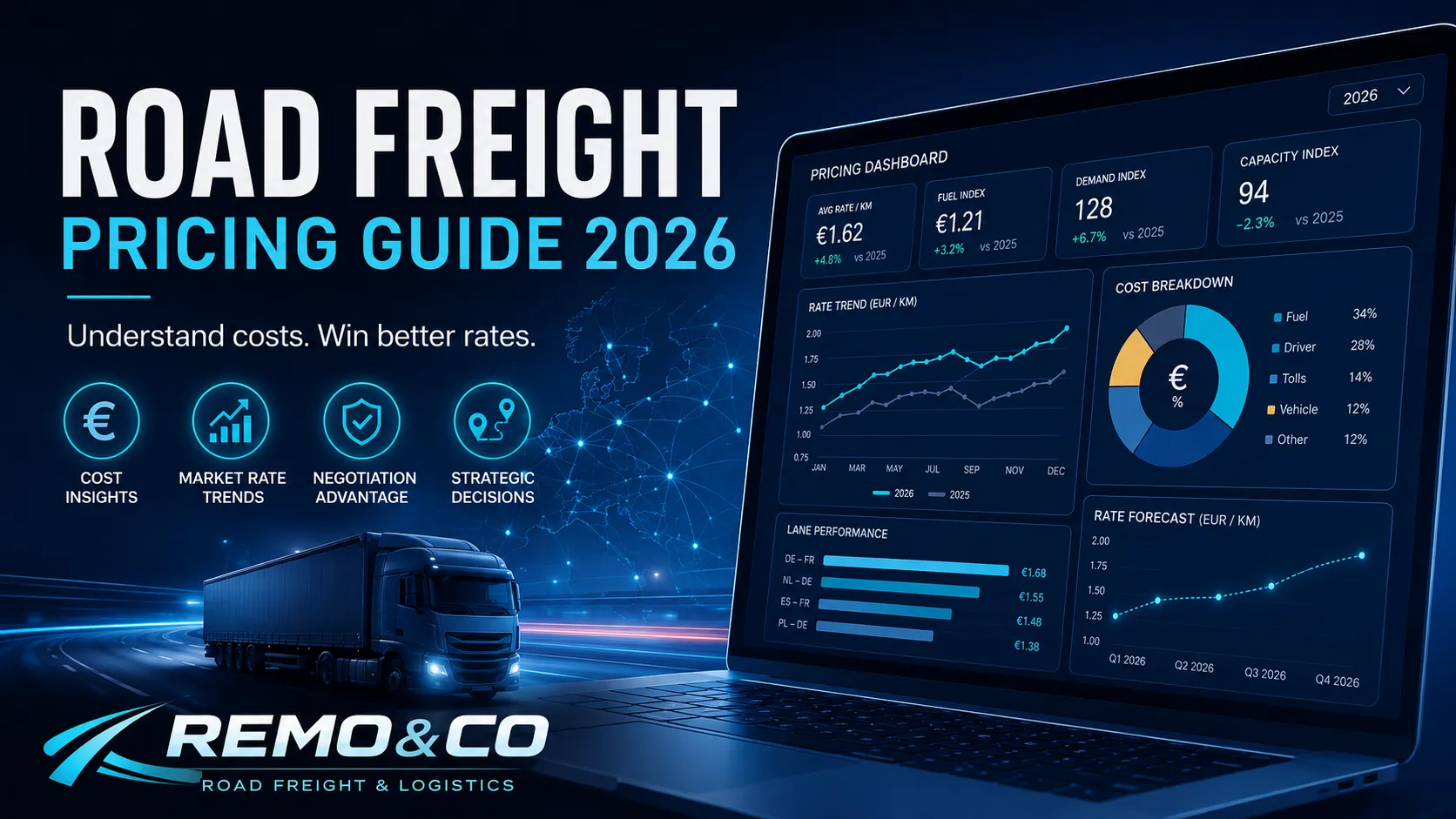
Road Freight Price per KM: What Really Affects Your Quote?
A practical guide to Road Freight Price per KM: What Really Affects Your Quote?, with decision tables, operator checklists, free Remo&Co tools and source-backed notes where compliance matters.